This post contains affiliate links. As an Amazon Associate, I earn from qualifying purchases — at no extra cost to you.
Say “gothic interior” out loud and most people picture the same wrong thing: black candelabras, a raven somewhere, velvet capes draped over a chaise that’s never actually sat in. It’s a costume department’s idea of the word, and it’s almost the opposite of what makes a room genuinely gothic. The real thing has no candles at all. It has plaster that’s cracked in one honest place, a window that lets in exactly as much light as the day has to give, and furniture old enough to have a memory. Gothic interior design, done right, isn’t a theme. It’s what a very old house looks like when nobody’s tried to update it.
That distinction is the whole post. Below are the four rooms that taught it to me, and what to actually go looking for if you want your own house to hold this feeling without turning your living room into a Halloween set.
Let the walls be the ghost story
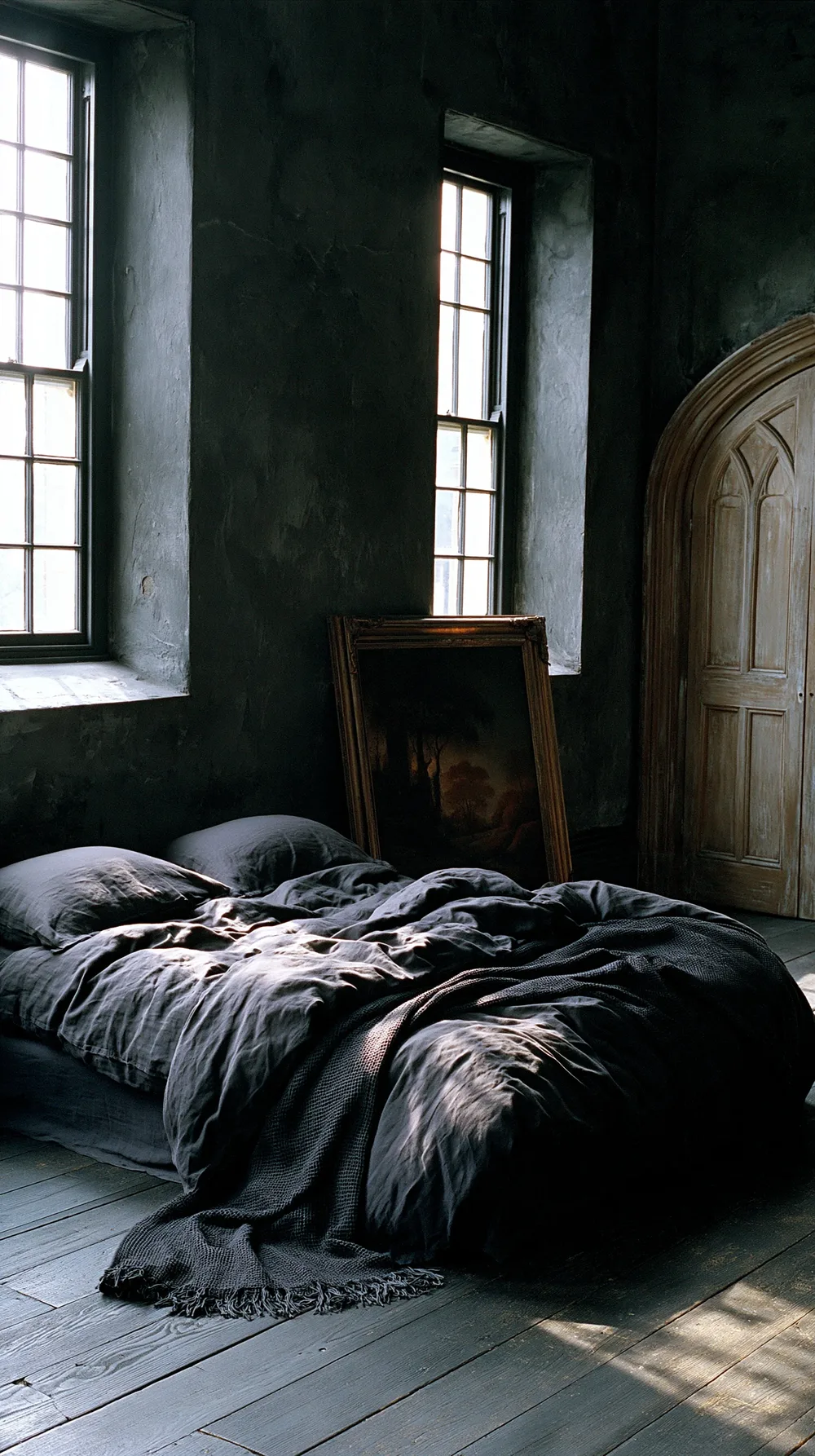
The bedroom in the photograph above is doing almost nothing, which is exactly why it works. Dark plastered walls with real texture — not a flat modern matte, but the kind of surface that catches light differently depending on where you’re standing. Two windows of different heights, because the room was built before symmetry became a design rule. An arched door in pale, unfinished wood, doing the one job gothic architecture always does: pointing your eye up. A gilt-framed painting simply leaning on the floor, not hung, because someone hasn’t gotten around to it yet and that unfinished-ness is more convincing than a curated gallery wall could ever be.
None of that costs a renovation. It costs a paint colour with the courage to go properly dark, and the restraint to stop there. Shop this charcoal gray flat interior paint →
The arch is the one architectural detail worth actually chasing if your house doesn’t have one. An arched mirror, an arched doorway insert, even an arched headboard will borrow the gothic grammar without touching a wall. Shop this arched wood wall mirror →
Let old furniture keep its imperfections
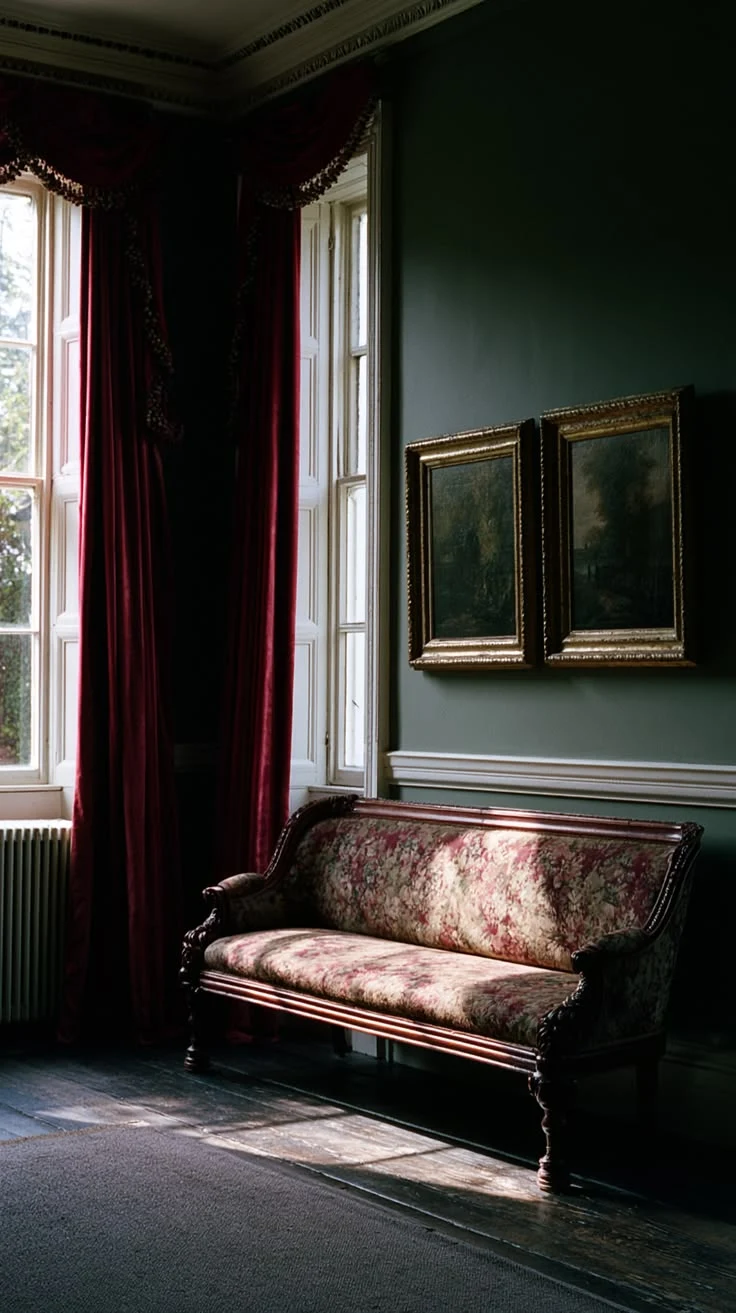
The settee’s upholstery is worn at the arm. The paintings are hung slightly uneven. Neither has been fixed, and the room is better for it.
This is the room people mean when they say “moody” without knowing why. Deep green walls with white-painted trim — the trim matters, because a gothic room with no light-catching detail anywhere goes flat and heavy instead of rich. Curtains in a real, saturated red velvet, hung floor to ceiling, doing the job curtains are supposed to do: control how much of the outside gets in. And a settee upholstered in a faded floral that’s clearly decades old, sitting exactly where a settee like that would have always sat.
The lesson from this room is about restraint with pattern. One patterned piece of furniture, a plain wall behind it, and a pair of paintings that repeat the same dark, aged tone rather than adding a new colour. Gothic rooms hold pattern in one place at a time. The settee itself is the kind of find worth hunting secondhand or at an antique dealer rather than buying new — but the curtains doing the real atmospheric work in this room are easy to source: shop this deep red velvet curtain pair →
A mirror is doing more work than a lamp ever will
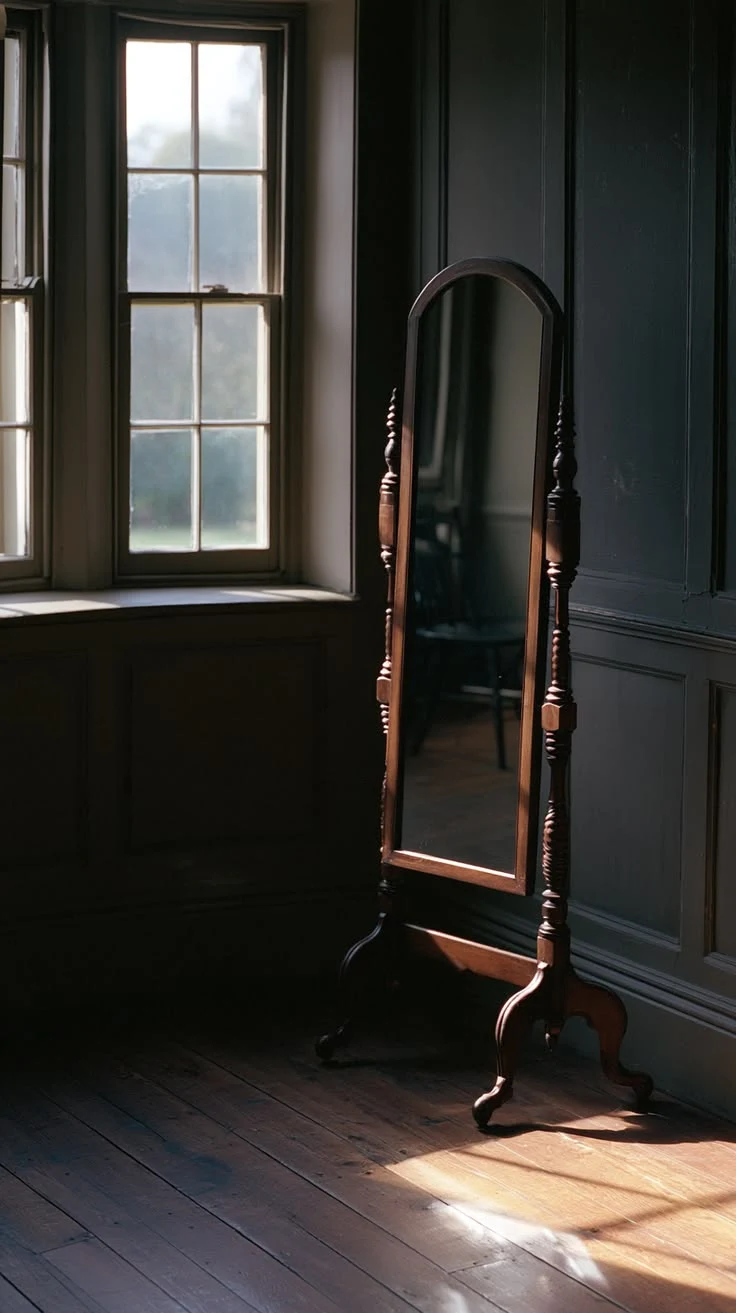
One mirror, one window, one floor. The room needed nothing else to have a mood.
Wood paneling, painted the same deep green-black as everything else in this house’s register, is the quiet workhorse of gothic interiors — it gives a flat drywall room the depth and grain a plastered stone one comes with for free. But the real subject of this photograph is the mirror. A freestanding cheval mirror, turned wood legs, standing in a plain shaft of window light with nothing arranged around it. It does the job three lamps couldn’t: it doubles the one available light source and gives the eye somewhere to land in an otherwise dark room.
If you’re choosing one gothic-coded object to add to a room you already have, make it this. It reads as inherited, not purchased, even when it’s neither. Shop this oak-finish freestanding cheval mirror →
Even the practical rooms get to keep the mood
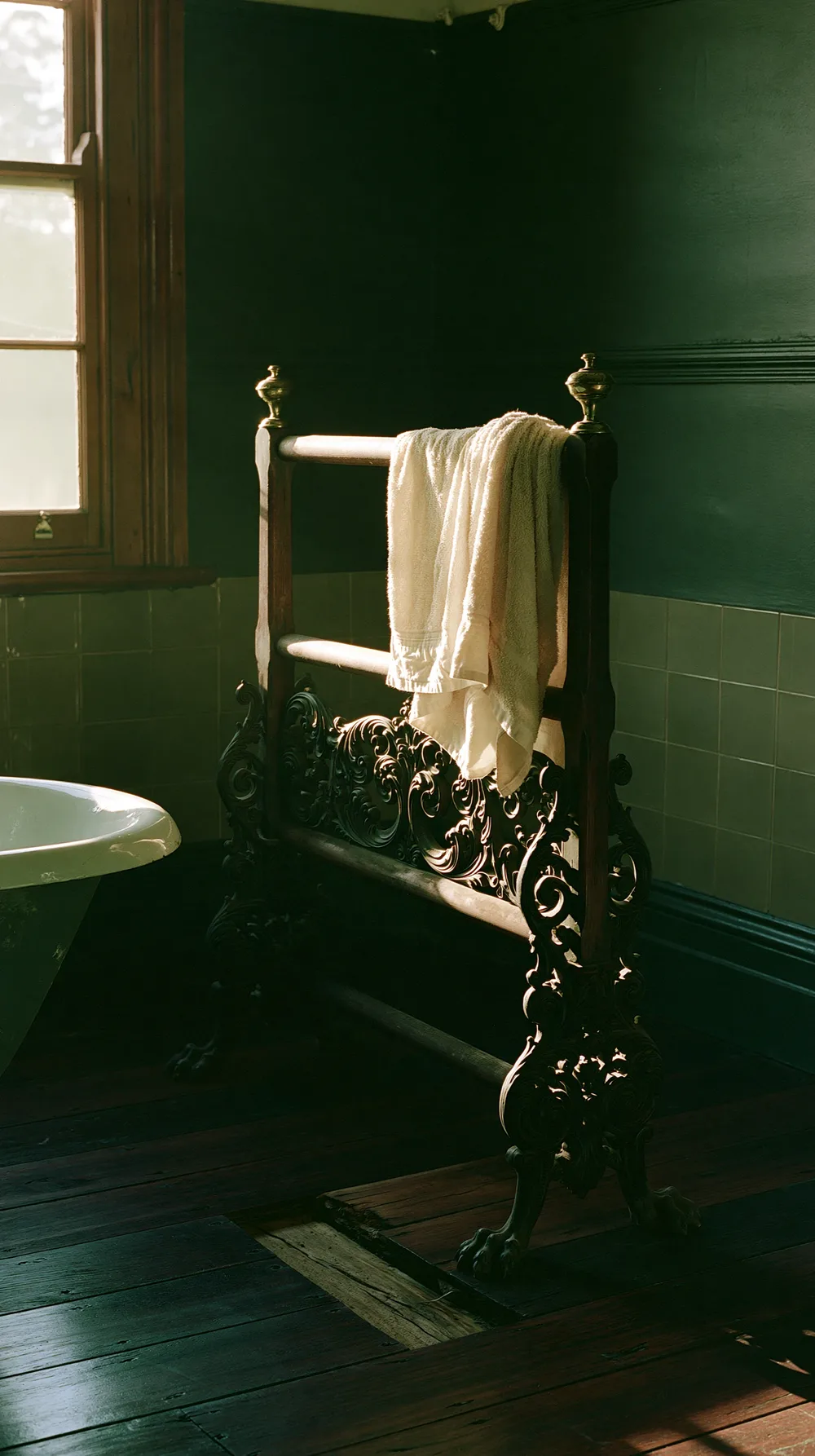
A towel rack is not a furniture decision most people make twice. This one earns the attention.
The mistake people make with a bathroom is assuming it has to be the one bright, clinical exception to the rest of the house. This one isn’t. Deep green walls down to a run of pale green tile, a clawfoot tub in the corner, and — the real hero — an antique brass towel rack with the kind of ornate scrollwork that would look absurd anywhere modern and looks entirely at home here. The brass has aged unevenly, which is the whole point; a rack that’s uniformly polished would break the spell instantly.
A clawfoot tub is a genuine renovation. A brass towel rack and a willingness to paint a bathroom a colour with actual depth are not — this exact piece, though, is the kind of find you keep an eye out for at an antique dealer or estate sale rather than order online. Nothing sold new quite has this weight to it.
The line to hold onto
Every room in this post shares one habit: nothing in them is trying to look gothic. The paint is just dark. The furniture is just old. The one ornate object per room — a mirror, a towel rack, a gilt frame — is allowed to be ornate precisely because everything around it is plain enough to let it be the one interesting thing. That’s the whole difference between gothic interior design and a haunted house rental: restraint, not accumulation. Pick your one dark colour, your one aged object, your one arch or one shaft of light, and then, unlike the theme park, stop.
For the room where this same restraint matters most — the one everyone walks past without decorating at all — the staircase deserves the same treatment. And if the plaster and paint in these photographs is what caught your eye, the case for dark walls goes deeper into why the colour choice matters more than anything you put in front of it.
From the shop
Prints from our own Duskwood Fell shop that suit this room. Instant digital downloads, printed at home or at any print shop.